About Blinded at Night
Blinded at Night began on a dark island road.
I live where the night is truly dark — where there are few streetlights, long curves, trees close to the shoulder, and stretches of road that depend entirely on your own vision. Over time, driving at night became increasingly difficult. When modern vehicles with bright white LED headlights approached, the light did not simply illuminate the road — it overwhelmed it.
For a few seconds after each passing vehicle, the road would disappear. The edge lines blurred. The shoulder dissolved into shadow. It felt less like inconvenience and more like disorientation.
And it was happening again and again.
At first, I wondered whether something was wrong with my eyes. But when I began researching, I discovered something important: this experience is widely reported. The shift to LED and HID headlights, higher vehicle profiles, sharper beam patterns, and increased traffic density has changed the visual environment of night driving.
Human vision did not change.
The challenge is real.
This book grew out of a simple desire: to understand what was happening and to find practical ways to drive safely and confidently at night — without the lingering sense that I might drift off the road during a moment of glare.
What I discovered is not alarmist, and it is not theoretical. It is practical. There are reasons modern headlights feel different. There are biological realities about how our eyes process contrast and brightness. And there are adjustments — some small, some strategic — that can meaningfully reduce glare and increase stability behind the wheel.
This work exists for those who have quietly adapted without language for what they are experiencing.
Once something is named clearly, it becomes manageable.
The night does not need to be conquered.
It can be understood.
And when it is understood, it can be met with steadiness again.
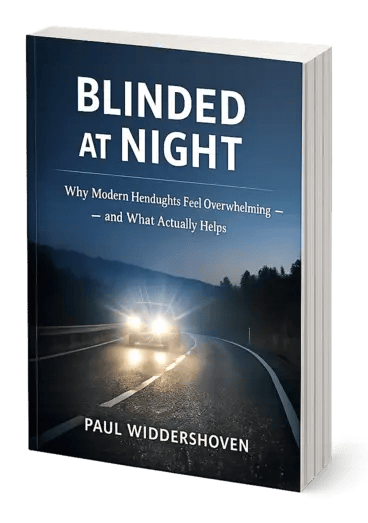
Blinded at Night
Why Modern Headlights Feel Overwhelming at Night— and What Actually Helps
About
Support
Privacy
Terms & Conditions
© 2026. All rights reserved.
Get tips and updates on night driving safety
Stay Informed