Why Are LED Headlights So Bright Now? Understanding Modern Headlight Glare
Modern LED headlights feel brighter than older halogen lights. Learn why headlights seem blinding now and what changed in vehicle lighting.
NIGHT DRIVING GLAREHEADLIGHT TECHNOLOGY
If Driving at Night Feels Different, It Is
If driving at night feels harder than it once did, that perception is not imagined.
Many drivers describe the same experience:
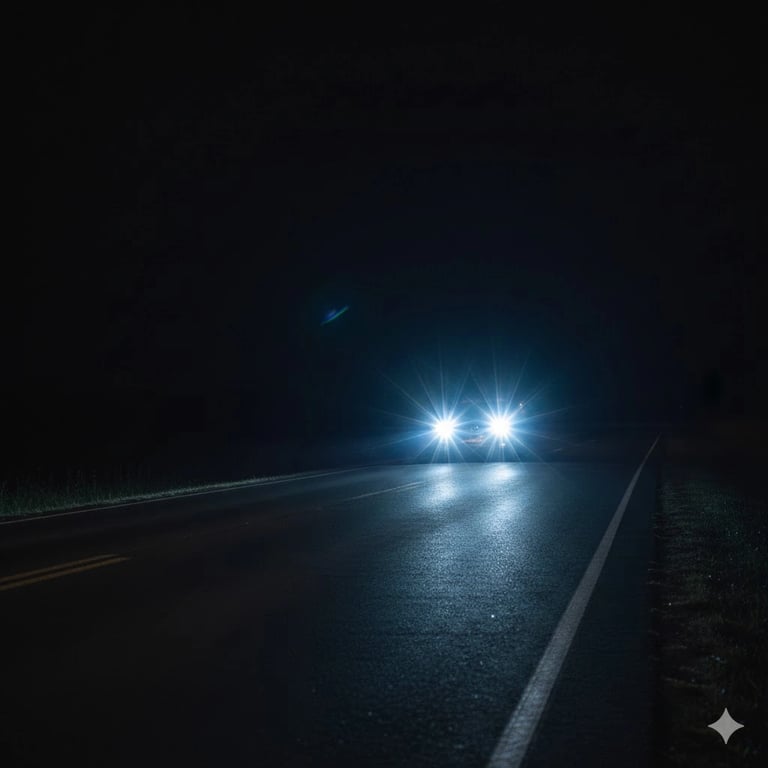
Oncoming headlights feel blinding rather than helpful
The road briefly disappears after cars pass
Glare lingers longer than expected
Confidence shifts, even on familiar routes
This is not limited to older drivers.
It is not limited to one diagnosis.
The driving environment itself has changed.
Understanding what changed restores steadiness.
What Changed in Modern Headlights
Over the past decade, vehicle lighting technology shifted significantly.
Older halogen headlights produced warmer, softer light.
Modern vehicles increasingly use LED and HID systems.
These systems:
Emit brighter light
Operate at higher color temperatures (whiter, sometimes blue-leaning)
Focus beams more sharply
Are mounted higher on taller vehicles such as SUVs and trucks
For the driver using them, this often improves forward visibility.
For the driver approaching them, the contrast can feel intense.
LED headlights commonly fall within the 5,000–6,500 Kelvin range. This appears closer to daylight than the warmer tones of older bulbs. In darkness, the human eye is more sensitive to blue-rich white light.
The result is stronger glare in certain conditions.
The change was gradual.
The effect accumulated.
Why Night Driving Glare Feels So Intense
At night, your eyes operate differently than during the day.
Pupils dilate to gather more light
Contrast sensitivity decreases
The eye becomes more vulnerable to scattered light
When a bright LED headlight enters a dark-adapted eye, the light can scatter inside the eye before reaching the retina. This is often called disability glare.
Even healthy eyes experience it.
The experience many drivers describe is not blindness.
It is momentary loss of usable detail.
For a second or two, edges soften. Lane markings fade. Depth perception shifts.
In motion, even a brief interruption feels significant.
Night driving glare is a real physical response to high contrast.
Why It Feels Worse Than It Used To
Several environmental shifts now overlap:
Vehicles are taller
Traffic density has increased
Headlight beams are more concentrated
Rural roads remain dark while vehicle lighting grows brighter
Human vision evolved to adapt to gradual shifts between light and dark — firelight, moonlight, dawn.
Repeated bursts of concentrated white light create a different visual pattern.
It is not dramatic.
It is cumulative.
Fatigue builds quietly.
Tension builds subtly.
Avoidance sometimes follows.
Is It Aging?
Age does affect night vision.
After about 40:
Pupils respond more slowly
The lens gradually becomes less transparent
Contrast sensitivity declines
But younger drivers also report increased difficulty with LED headlights.
This suggests the experience is not explained by age alone.
It is environmental and biological interacting.
If glare has suddenly worsened, or halos and visual distortions appear consistently, an eye exam is worthwhile.
Most experiences of night driving glare, however, are multi-factorial rather than caused by a single disease.
Practical Ways to Reduce Night Driving Glare
Small adjustments often restore steadiness.
1. Shift Your Focus Slightly
When oncoming vehicles approach, look toward the right edge line of your lane rather than directly into headlights. Peripheral awareness remains intact.
2. Keep Glass Surfaces Clear
Clean your windshield inside and out. Even light film dramatically increases light scatter.
3. Dim Dashboard Illumination
Bright interior lighting reduces your eye’s ability to adapt to darkness.
4. Ensure Proper Prescription
Mild uncorrected astigmatism increases glare effects. An updated prescription can help.
5. Consider Anti-Reflective Coatings
If you wear glasses, anti-reflective coatings reduce internal reflections.
6. Moderate Speed in High-Glare Conditions
A slight reduction in speed lowers cognitive load and restores confidence.
These are not concessions.
They are responses to a changed environment.
Do Yellow Night Driving Glasses Work?
Yellow-tinted lenses reduce some blue light transmission.
For some drivers, this increases perceived contrast.
However:
They also reduce total light entering the eye
Evidence for meaningful safety improvement is mixed
Results vary between individuals
They are not a universal solution.
Clarity depends on the whole visual system, not a single filter.
When to Seek Medical Evaluation
Consult an eye professional if:
Glare worsens rapidly
Halos appear consistently
Double vision occurs
Daytime vision is also affected
Conditions such as cataracts, corneal irregularities, or dry eye can amplify glare.
Most night driving glare, however, reflects environmental intensity interacting with normal visual physiology.
Restoring Confidence at Night
The experience of being briefly blinded unsettles the nervous system.
It can create tension before sunset.
Understanding what changed reduces that tension.
Modern headlights are brighter.
Human vision remains human.
Adaptation restores agency.
The night does not need to be mastered.
It needs to be met with awareness and adjustment.
A Fuller Exploration
This page explains the mechanics of night driving glare and practical ways to adapt safely.
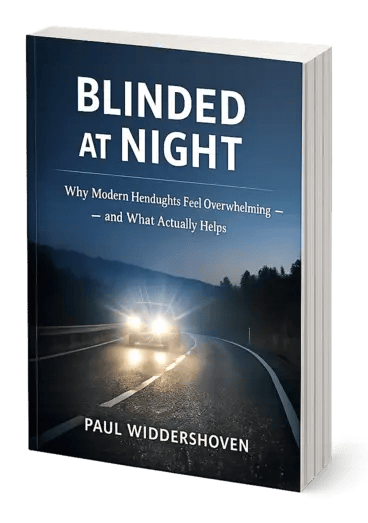
For a deeper exploration of how modern headlights changed the experience of driving after dark — and how steadiness can be restored — Blinded at Night expands on this shift with clarity and calm.
Explore the deeper study in Blinded at Night.
Blinded at Night
Why Modern Headlights Feel Overwhelming at Night— and What Actually Helps
About
Support
Privacy
Terms & Conditions
© 2026. All rights reserved.
Get tips and updates on night driving safety
Stay Informed